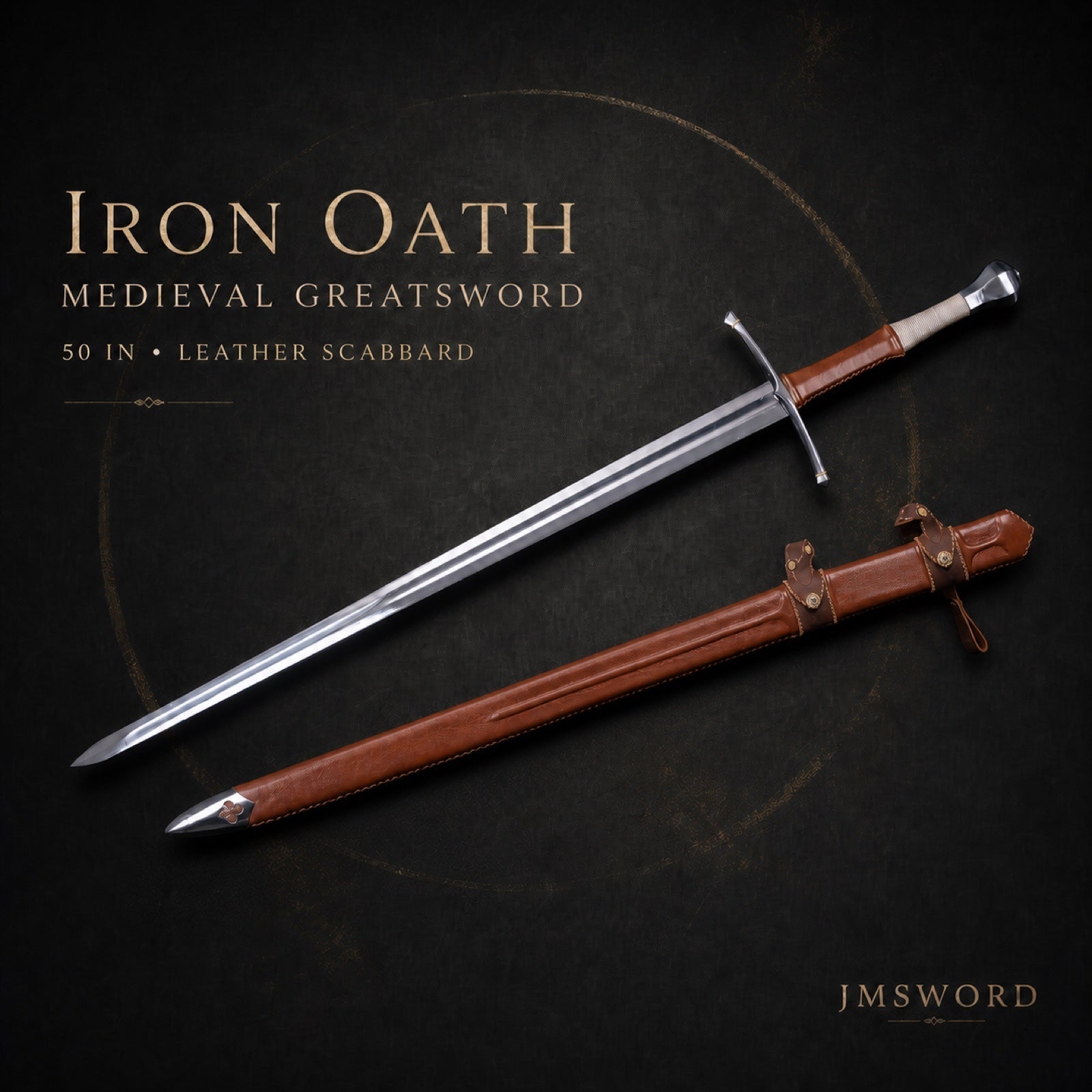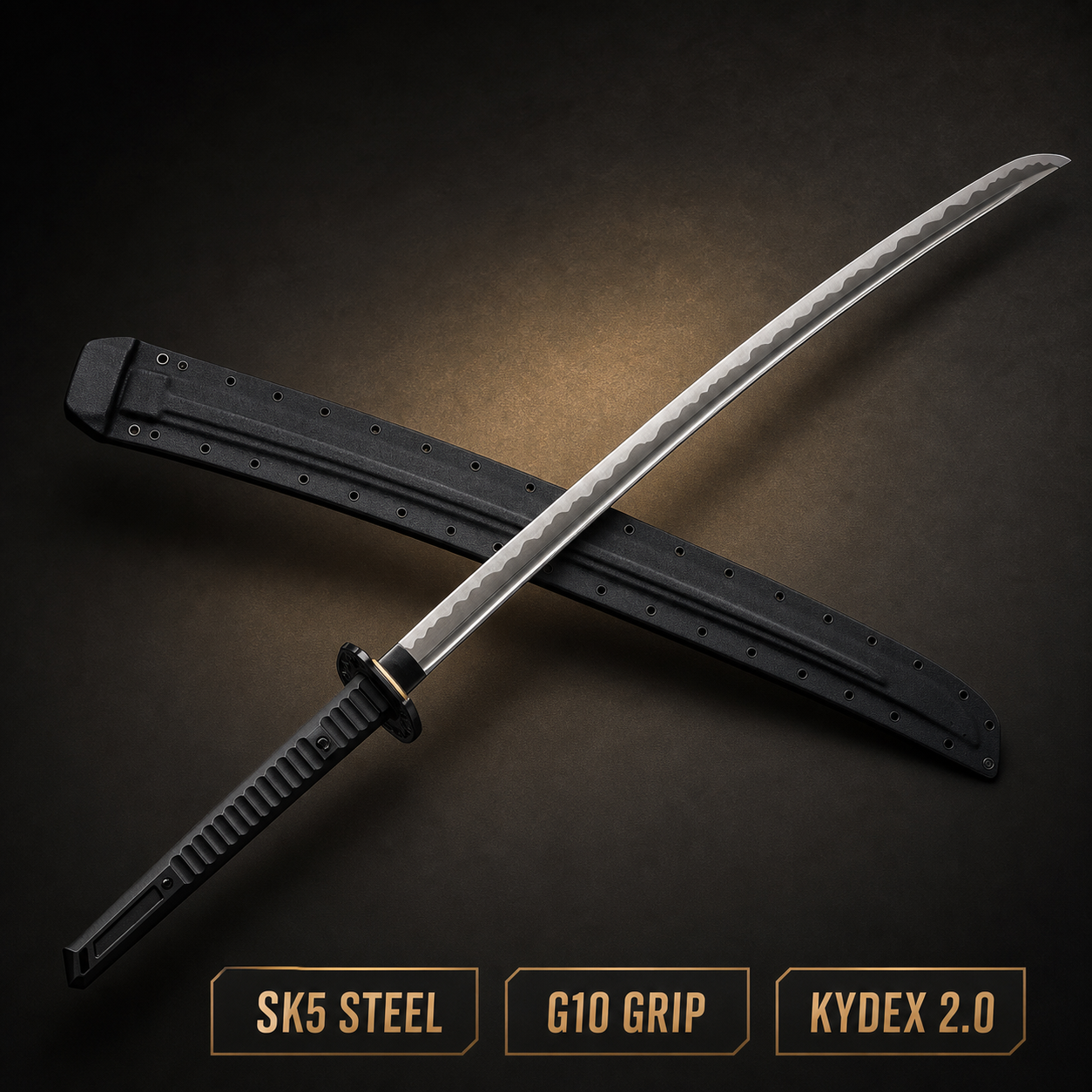

When a sword listing says “full tang,” it is describing the part of the blade that continues inside the handle. That hidden structure matters, but the phrase is often used too loosely. It can refer to more than one construction style, and it does not prove that every other part of the sword is well made.
This guide explains what a sword tang is, how full-length hidden tangs differ from exposed full-width tangs, and what a collector can realistically verify before ordering.
What is the tang of a sword?
The tang is the extension of the blade that enters the grip. It connects the blade to the rest of the hilt: the guard, grip and pommel. Although most of it is concealed after assembly, its dimensions and attachment method influence the stability of the finished sword.
A tang is not a separate accessory that should be casually added to a finished blade. In a sound construction, it is designed as part of the blade and matched to the hilt components. The exact shape varies with sword type, period, maker and manufacturing method.
What does “full tang” mean on a sword listing?
In general retail language, full tang means that the blade’s steel continues through most or all of the handle length. The important idea is continuity between blade and hilt. However, sword terminology differs from the language commonly used for kitchen knives.
On a knife, “full tang” often means a broad strip of steel that remains visible between two handle scales. Many European swords instead use a long hidden tang enclosed by the grip and secured at the pommel. Japanese-style swords traditionally use a hidden tang called the nakago, retained within a removable hilt assembly. Both can be full-length constructions even though the steel is not visible along the sides of the handle.
Common tang constructions
Full-width exposed tang
The tang follows much of the outline of the grip, with handle scales attached on each side. This style is easy to recognize on many modern tactical designs, knives and machete-inspired swords. Visible construction can make inspection simpler, but the fit, fasteners, steel treatment and grip design still matter.
Full-length hidden tang
The tang extends through the grip while remaining enclosed by wood, leather, cord or another handle system. It may be peened over the pommel, secured by a threaded assembly, pinned in place or retained by a construction specific to the sword tradition. A hidden tang is not automatically a weak tang.
Partial tang
A partial tang stops before reaching the end of the handle. This can be appropriate for a decorative object designed only for static display, but the listing should describe the intended purpose honestly. Buyers should not assume that an unverified decorative construction is suitable for dynamic handling.
Narrow or welded rod construction
Collectors sometimes use “rat-tail tang” to describe a very narrow rod, especially one welded to the blade shoulder. The concern is not the nickname itself but the abrupt transition, limited cross-section or questionable joint hidden inside the grip. Avoid making a judgment from marketing language alone; ask for a clear construction description.
Why tang construction matters
The hilt receives load whenever a sword is moved, stopped or accidentally knocked. A well-proportioned tang helps transfer that load through the handle assembly without concentrating it at a weak joint. It also gives the guard, grip and pommel a stable foundation.
Tang dimensions can affect mass distribution, but they do not determine balance by themselves. Blade profile, distal taper, guard and pommel all contribute. For a complete comparison, read the JMSWORD guide to sword length, weight and balance.
What full tang does not guarantee
“Full tang” is one specification, not a complete quality certificate. A sword can have a long tang and still suffer from poor heat treatment, rough transitions, loose fittings, unsuitable geometry or an inaccurate product description. Conversely, a historically appropriate hidden tang can be strong without resembling the exposed tang of a modern knife.
- Steel grade: the alloy name does not reveal the complete heat-treatment process.
- Blade geometry: thickness, taper, width and edge configuration affect the finished structure.
- Hilt fit: the guard, grip and pommel should remain secure without movement.
- Assembly method: peened, threaded and pinned systems each require good execution.
- Intended purpose: display, controlled practice and other uses require different products and supervision.
See the JMSWORD sword steel guide for another example of why a single specification should not be judged in isolation.
How to evaluate tang information when buying online
You usually cannot see the tang in finished product photos, and you should not disassemble a sword merely to investigate it. Instead, look for documentation and ask specific questions.
- Read the complete specifications. Look for “full-length hidden tang,” “peened tang,” “threaded pommel,” “pinned construction” or another precise description.
- Check whether the seller distinguishes display pieces from other products. Vague labels such as “real” or “battle ready” are less useful than measurable specifications.
- Review hilt photographs. Clear images of the pommel, fasteners and grip seams can support a description, although they cannot reveal the entire hidden structure.
- Ask before ordering. If tang construction is important to your purchase, request confirmation for that exact model.
- Do not perform an impact test. Striking hard objects is not a safe or reliable way to verify construction and can damage the sword or injure people nearby.
Full tang buyer checklist
- Is the tang described as full length, full width, hidden, peened, threaded or pinned?
- Is the sword intended for display, collection or a clearly defined supervised activity?
- Are steel, overall length, blade length, weight and included scabbard listed?
- Are the guard, grip and pommel shown clearly?
- Can the seller answer a model-specific construction question?
- Have you planned secure storage and checked local ownership and shipping rules?
Final takeaway
For swords, full tang usually means that the blade steel continues through the handle, but it may be exposed or hidden. The phrase is useful only when it is supported by a precise description of the hilt construction. Treat tang design as one part of the complete sword, alongside steel, heat treatment, geometry, dimensions and assembly.
Continue with the JMSWORD Sword Guide, or compare current specifications in the tactical sword collection and medieval sword collection.